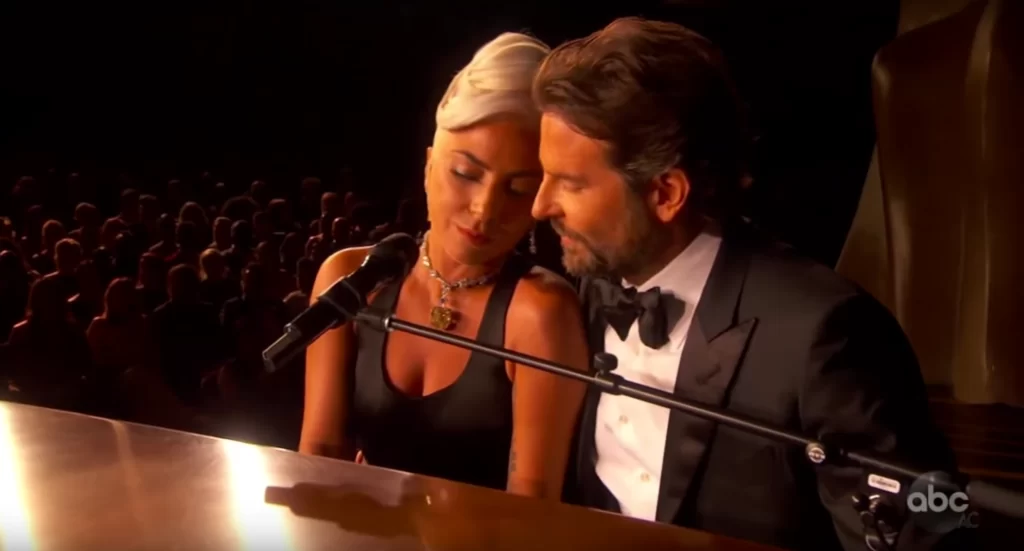
Perhaps you’ve seen video of Lady Gaga and Bradley Cooper singing Shallow together at the 2019 Oscars broadcast. (Shallow, from the 2018 film A Star is Born, won the Oscar for best original song that year.) If you missed this duet, a quick web search will lead you to it. Viewers, apparently, didn’t take the performance to be shallow at all; as one critic suggested, “Just about anyone who watched the Academy Awards…likely came away…believing Lady Gaga and her ‘A Star is Born’ co-star Bradley Cooper were deeply and madly in love” (Kubota, 2019). That belief may testify to the power of their performance, but it also conflates observed behaviors and underlying feelings in a manner representative of a general cognitive pattern called “Correspondence Bias” (also known as the “Fundamental Attribution Error”–see Note 1 below).
What is “Correspondence Bias”?
First, “correspondence” in social perception refers to a tendency to infer the existence of an individual’s general personal preference matching the character of an observed action, in the example at hand, to view the two singers’ intertwined behaviors as indicative of underlying love. It’s not uncommon for perceivers to account for social behavior in terms of individuals’ broad tendencies or dispositions, including their likes, attitudes, and personality traits.
Whether the propensity to interpret behavior as reflective of underlying personal characteristics represents a bias is controversial; “bias” implies perceivers rely too heavily on dispositional constructs and give insufficient weight to other factors potentially influencing behavior. [See Note 2 below for additional discussion of this issue.]
Social psychologist Ned Jones, a key figure in the research literature on correspondence bias, claimed the following:
“I have a candidate for the most robust and repeatable finding in social psychology: the tendency to see behavior as caused by a stable personal disposition of the actor when it can be just as easily explained as a natural response to more than adequate situational pressures” (1990, p. 138).
Lady Gaga, for example, later reminded people she and Bradley Cooper were experienced entertainers—that was their vocation—and the two had crafted and rehearsed their performance thoroughly. What viewers encountered was only an accomplished outcome of roles the singers had assumed. In this case, correspondence bias seems to have resulted in a misperception, one often experienced by individuals enacting roles (e.g., actors and lawyers; see the testimonials presented on the “CB in Life” page linked below).
More generally, as Jones suggested, it may be that correspondence bias shows misjudgments of the extent to which external factors have shaped a wide variety of everyday observed behaviors and outcomes. Everything from chance (e.g., Konnikova, 2020) to powerful social constraints (e.g., Kuran, 1997) to subtle social-situational influences (e.g., Cialdini, 2021) may affect human behavior and the courses of lives. However, perceivers may favor psychological explanations in the form of inferred personal tendencies and preferences to account for what they see. Students of psychology may recognize that while observers might strongly attribute the behavior of participants in classic authority, conformity, and helping behavior studies to underlying characteristics of the individuals acting (e.g., their callousness towards others), close scrutiny suggests external social-situational influences may largely make sense of participants’ behavior. Thus, correspondence bias may be a significant and pervasive feature of human understanding.
Correspondence Bias in the Lab
The dense circumstances of a single real-life example, such as reactions to Lady Gaga and Bradley Cooper’s duet, make it difficult to know what occurred in that instance of social perception. What psychological scientists attempt to do is to demonstrate phenomena in experiments in order to isolate and evaluate factors potentially influencing an outcome of interest. How can we examine how perceivers respond to circumstances where others exhibit behaviors or voice beliefs largely due to assigned roles? That’s what a foundational study by Jones and Harris (1967) addressed. This study is important for the evidence it provided, for the basic research method it introduced, and for the subsequent analyses and investigations of correspondence bias it sparked.
__________________________________________________________________________
SUMMARY QUESTIONS FOR STUDENT CONSIDERATION:
1.Share your understanding of “correspondence bias.” How might correspondence bias make sense of reactions to the Lady Gaga and Bradley Cooper duet?
2.The discussion above suggested external rather than internal factors often contribute substantially to observed outcomes. Although that claim is not the focus of this module, can you identify examples and evidence consistent with it?
3.Why is it important for scientists to reconstruct and systematically study psychological phenomena in research? What possible complications arise when basing claims about human psychology on the analysis of real world examples?
__________________________________________________________________________
NEXT STEP:
To learn about the foundational research study on correspondence bias by Jones and Harris, click here.
To see additional brief examples of and testimonials to correspondence bias by public figures, click here for the “CB in Life” page. Note: you’ll still be able move to the research study page after visiting the “CB in Life” page.
__________________________________________________________________________
